Fractional drill bit sizes
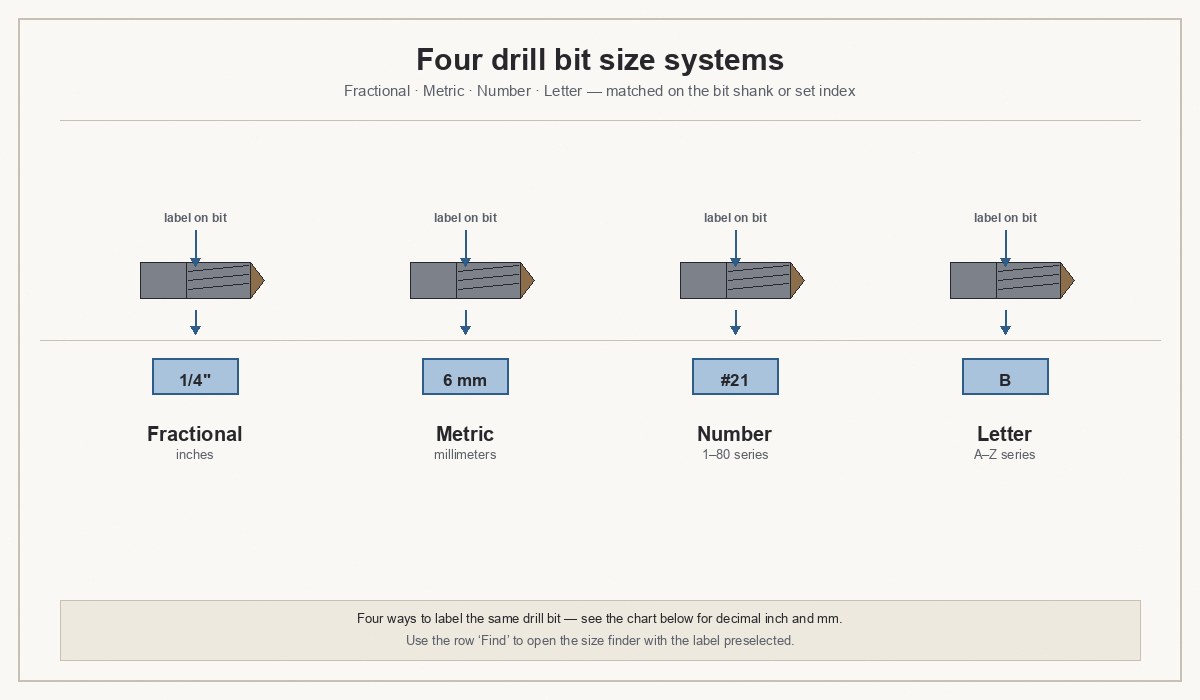
Inch-fraction series only — the labels most US consumer drill indexes print on the case. Each row lists the fraction, decimal inch, and millimeter equivalent so you can match a drawing or a bit shank without opening the full four-system chart. Need metric, number, or letter sizes? Use the links below or the full chart.
Full size chart · Size finder · Drill hub · Metric · Number · Letter
How to use this table
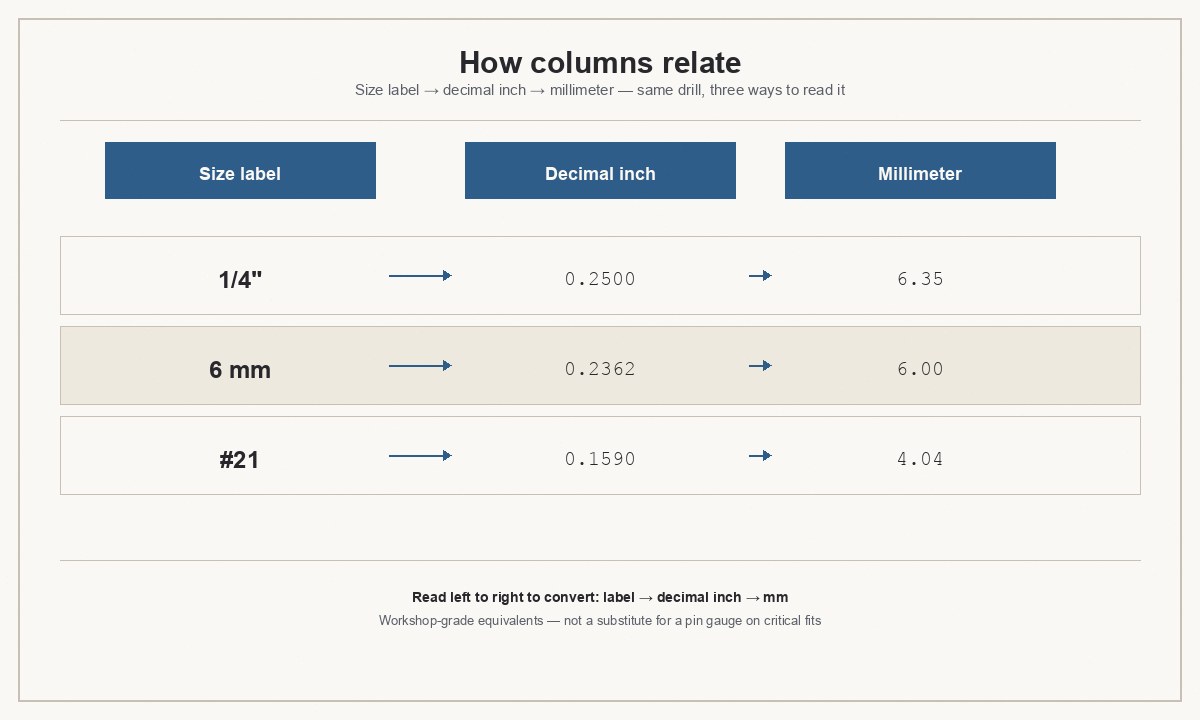
Scan the Size column for the fraction on your bit or plan. Decimal inch helps when a drawing shows 0.250 instead of 1/4". The mm column is a shop equivalent (inch×25.4), not a claim of lab tolerance. Click Find on a row to open the size finder with that label preselected — that path is where kit matching lives. Mapped fractional staples (1/16"–1/2" common steps) resolve to an explicit kit entry; shopping still happens on the tool page, not as a product grid here.
Fractional steps are coarser than number or letter series. If 1/4" is slightly large for a pilot and 3/16" is small, check the full chart number/letter blocks or a tap-drill reference before forcing a fit. For screw pilots and clearance holes, pair this table with a screw→drill workflow when available — diameter alone does not choose thread engagement.
Typical shop flow: read the fraction on the plan or the worn stamp on a loose bit, find the row, note decimal and mm if you need to cross-check a metric bit box, then Find → size finder for kit context. Do not treat every row as a buy button. This fractional-only list stays a quiet reference so the flagship chart and the finder can own navigation and commerce. Printable or job-site use is fine; critical aerospace or bearing fits still need a gauge.
If your case skips a common step (many 21-piece sets jump unevenly), the missing fraction is still listed here for identification. Map coverage for kits focuses on staples that consumer titanium sets actually print on the lid — that is why hub chips promote mapped fractionals only. Unmapped long-tail fractions still look up; the kit card may show the default set with an honest default note instead of a fake “includes this size” claim.
| Size | Inch (dec) | mm | Look up |
|---|---|---|---|
| 1/64" | 0.0156 | 0.40 | Find → |
| 1/32" | 0.0312 | 0.79 | Find → |
| 3/64" | 0.0469 | 1.19 | Find → |
| 1/16" | 0.0625 | 1.59 | Find → |
| 5/64" | 0.0781 | 1.98 | Find → |
| 3/32" | 0.0938 | 2.38 | Find → |
| 7/64" | 0.1094 | 2.78 | Find → |
| 1/8" | 0.1250 | 3.17 | Find → |
| 9/64" | 0.1406 | 3.57 | Find → |
| 5/32" | 0.1562 | 3.97 | Find → |
| 11/64" | 0.1719 | 4.37 | Find → |
| 3/16" | 0.1875 | 4.76 | Find → |
| 13/64" | 0.2031 | 5.16 | Find → |
| 7/32" | 0.2188 | 5.56 | Find → |
| 15/64" | 0.2344 | 5.95 | Find → |
| 1/4" | 0.2500 | 6.35 | Find → |
| 17/64" | 0.2656 | 6.75 | Find → |
| 9/32" | 0.2812 | 7.14 | Find → |
| 5/16" | 0.3125 | 7.94 | Find → |
| 11/32" | 0.3438 | 8.73 | Find → |
| 3/8" | 0.3750 | 9.52 | Find → |
| 13/32" | 0.4062 | 10.32 | Find → |
| 7/16" | 0.4375 | 11.11 | Find → |
| 15/32" | 0.4688 | 11.91 | Find → |
| 1/2" | 0.5000 | 12.70 | Find → |
| 9/16" | 0.5625 | 14.29 | Find → |
| 5/8" | 0.6250 | 15.88 | Find → |
| 11/16" | 0.6875 | 17.46 | Find → |
| 3/4" | 0.7500 | 19.05 | Find → |
| 13/16" | 0.8125 | 20.64 | Find → |
| 7/8" | 0.8750 | 22.22 | Find → |
| 15/16" | 0.9375 | 23.81 | Find → |
| 1" | 1.0000 | 25.40 | Find → |
Common drill bit set
This page is for lookup. One optional set covers common fractional staples (1/16"–1/2" range on many lids). Use Find on a row for a label-specific match in the size finder.
As an Amazon Associate we earn from qualifying purchases. Disclosure
FAQ
What are fractional drill bit sizes?
Fractional sizes are inch fractions such as 1/16", 1/8", and 1/4". They are the labels most home and job-site index cases use in the US.
How do fractional sizes compare to millimeters?
Use the mm column on each row. For example, 1/4" is 6.35mm nominal. For a metric drawing, pick the nearest fractional row or open the full chart metric block.
Which fractional sizes belong in a starter set?
Common shop staples are 1/16", 1/8", 3/16", 1/4", 3/8", and 1/2". Click Find on a row to open the size finder with that label and a kit when the size is mapped.
Where is the full four-system chart?
Open the drill bit size chart for fractional, metric, number, and letter together. This page is the fractional series only for faster scanning.
Sources
Fractional progressions follow common published inch drill indexes. Millimeter values are nominal conversions for workshop comparison. Confirm critical fits on the bit or with a gauge.
See the site disclaimer for limits of use.