Drill Bit Size Chart
Four common size systems in one reference table: fractional inch, metric millimeters, number (#), and letter (A–Z). Each row shows the shop label plus decimal-inch and mm so you can compare systems without flipping between catalogs. Shopping stays on the size finder — this page is for lookup and cross-check, not a product wall.
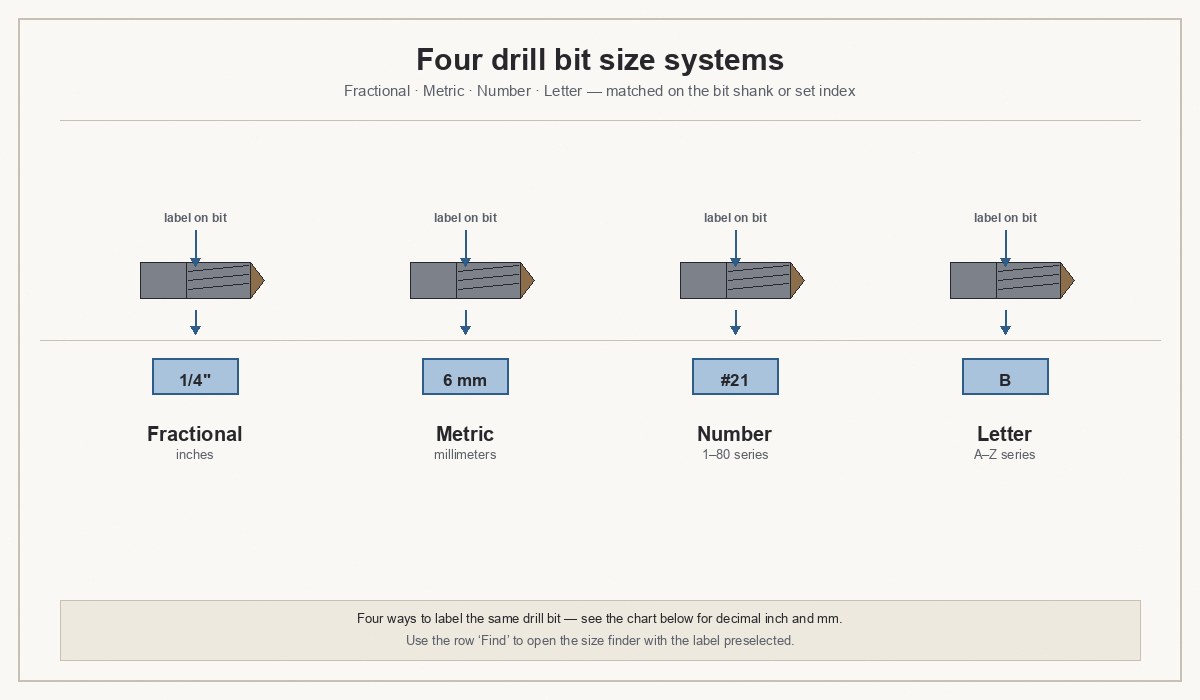
Fractional sizes
Inch fractions such as 1/4" and 3/8".
| Size | Inch (dec) | mm | Look up |
|---|---|---|---|
| 1/64" | 0.0156 | 0.40 | Find → |
| 1/32" | 0.0312 | 0.79 | Find → |
| 3/64" | 0.0469 | 1.19 | Find → |
| 1/16" | 0.0625 | 1.59 | Find → |
| 5/64" | 0.0781 | 1.98 | Find → |
| 3/32" | 0.0938 | 2.38 | Find → |
| 7/64" | 0.1094 | 2.78 | Find → |
| 1/8" | 0.1250 | 3.17 | Find → |
| 9/64" | 0.1406 | 3.57 | Find → |
| 5/32" | 0.1562 | 3.97 | Find → |
| 11/64" | 0.1719 | 4.37 | Find → |
| 3/16" | 0.1875 | 4.76 | Find → |
| 13/64" | 0.2031 | 5.16 | Find → |
| 7/32" | 0.2188 | 5.56 | Find → |
| 15/64" | 0.2344 | 5.95 | Find → |
| 1/4" | 0.2500 | 6.35 | Find → |
| 17/64" | 0.2656 | 6.75 | Find → |
| 9/32" | 0.2812 | 7.14 | Find → |
| 5/16" | 0.3125 | 7.94 | Find → |
| 11/32" | 0.3438 | 8.73 | Find → |
| 3/8" | 0.3750 | 9.52 | Find → |
| 13/32" | 0.4062 | 10.32 | Find → |
| 7/16" | 0.4375 | 11.11 | Find → |
| 15/32" | 0.4688 | 11.91 | Find → |
| 1/2" | 0.5000 | 12.70 | Find → |
| 9/16" | 0.5625 | 14.29 | Find → |
| 5/8" | 0.6250 | 15.88 | Find → |
| 11/16" | 0.6875 | 17.46 | Find → |
| 3/4" | 0.7500 | 19.05 | Find → |
| 13/16" | 0.8125 | 20.64 | Find → |
| 7/8" | 0.8750 | 22.22 | Find → |
| 15/16" | 0.9375 | 23.81 | Find → |
| 1" | 1.0000 | 25.40 | Find → |
Full fractional series: open series page .
Metric sizes
Millimeters such as 3mm and 6.5mm.
| Size | Inch (dec) | mm | Look up |
|---|---|---|---|
| 1mm | 0.0394 | 1.00 | Find → |
| 1.5mm | 0.0591 | 1.50 | Find → |
| 2mm | 0.0787 | 2.00 | Find → |
| 2.5mm | 0.0984 | 2.50 | Find → |
| 3mm | 0.1181 | 3.00 | Find → |
| 3.5mm | 0.1378 | 3.50 | Find → |
| 4mm | 0.1575 | 4.00 | Find → |
| 4.5mm | 0.1772 | 4.50 | Find → |
| 5mm | 0.1969 | 5.00 | Find → |
| 5.5mm | 0.2165 | 5.50 | Find → |
| 6mm | 0.2362 | 6.00 | Find → |
| 6.5mm | 0.2559 | 6.50 | Find → |
| 7mm | 0.2756 | 7.00 | Find → |
| 8mm | 0.3150 | 8.00 | Find → |
| 9mm | 0.3543 | 9.00 | Find → |
| 10mm | 0.3937 | 10.00 | Find → |
| 12mm | 0.4724 | 12.00 | Find → |
Full metric series: open series page .
Number sizes
Number sizes such as #7 and #21.
Full number series: open series page .
Letter sizes
Letter sizes A–Z.
Full letter series: open series page .
How to read this chart
Start with the system your drawing or bit set already uses. Fractional labels look like 1/4" and match most consumer index cases. Metric labels are millimeters (for example 6mm). Number sizes use a hash prefix (#7, #21). Letter sizes run A through Z. The Size column is the label you match on the shank, the case, or the Amazon kit title — not a brand SKU.
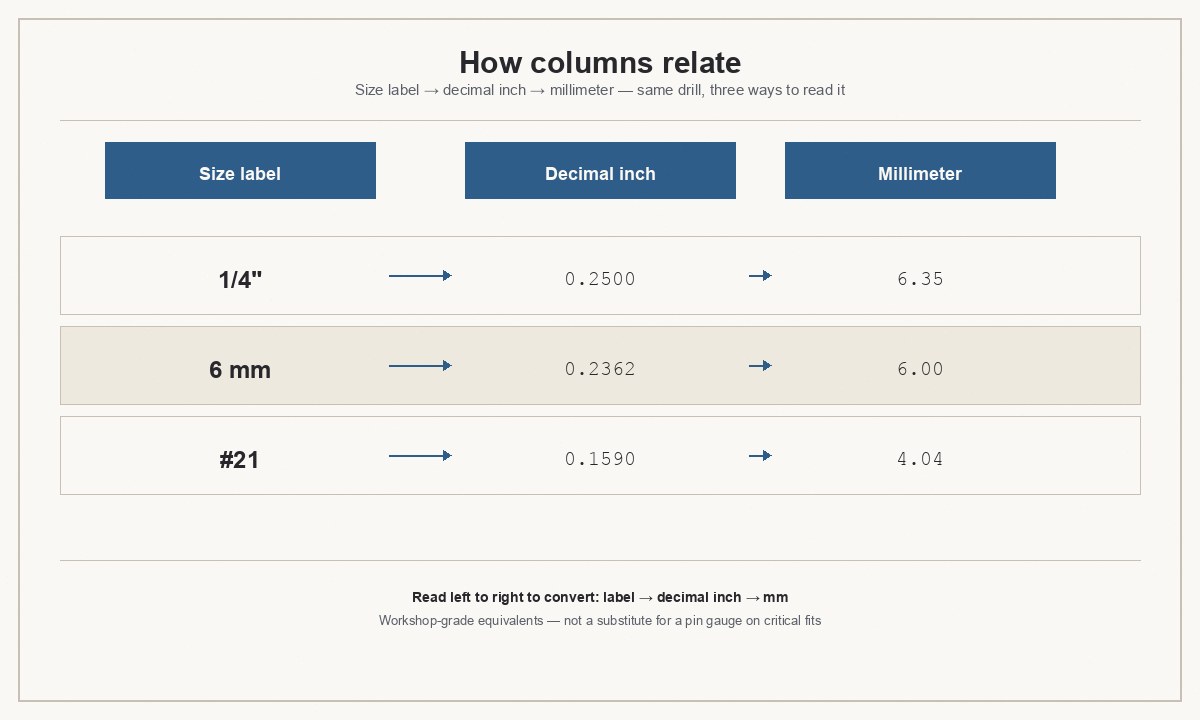
Decimal inch and mm sit beside each label so you can cross-walk systems. If a plan calls for 6mm and your set is fractional only, scan the fractional block for the nearest decimal or open the finder to compare. Values are workshop-grade equivalents; they are not a substitute for a pin gauge when a press fit or bearing bore is critical.
Use Find on a row to open the size finder with that label preselected. The finder is the next step after you pick a size: confirm the label, then a single kit card when that size is in our shop list. Prefer common fractional shop staples (1/16" through 1/2") when you want a set that honestly lists the size. Number, letter, and metric labels still look up correctly on the chart even when shop matching falls back to a common fractional set.
- Size — label printed on the bit or in the set index.
- Inch (dec) — decimal inch for quick comparison.
- mm — millimeter equivalent for metric drawings and bits.
- Find — deep-links to the finder with
?label=.
Common drill bit set
Main CTA above is Find your size. After the table, one optional set covers common fractional shop staples (confirm the exact label on the product). Prefer the finder when you already know the size.
As an Amazon Associate we earn from qualifying purchases. Disclosure
When to leave this chart
Need one series only? Open a series page (fractional, metric, number, or letter) for a quieter table. Already know the label and want a set? Skip straight to the size finder . Matching a screw to a pilot or clearance hole is a different job — use the screw→drill tool when that ships for your fastener, not this diameter chart alone.
FAQ
What is the difference between fractional and number drill bits?
Fractional bits use inch fractions such as 1/4". Number bits use the #1–#80 series with finer steps, often for small holes and tap drill work. Compare both with the decimal-inch and mm columns on this chart.
How do I convert a drill bit size to millimeters?
Read the mm column on the same row, or open the size finder with that label. Millimeters here are nominal equivalents for shop comparison, not a claim of metrology-lab precision.
How do I use this chart with the size finder tool?
Click Find on any row, or use Find your size above. The finder opens with that label preselected so you can confirm decimal/mm and see a set that lists the size when the product includes it.
Is this an official engineering chart?
No. It is a workshop reference built from common published size systems. Confirm critical fits on the bit shank or manufacturer table. See the site disclaimer for limits of use.
Which drill bit sizes are best for a starter set?
Most home shops start with common fractionals: 1/16", 1/8", 3/16", 1/4", 3/8", and 1/2". Use Find on those rows to open the finder and a set that includes the label. Number and letter sizes matter more once you tap or match odd pilots.
Why do number and letter sizes exist if fractions already cover inches?
Fractions jump in coarse steps. Number and letter series fill gaps used by taps, rivets, and older machinery drawings. When a fraction is slightly large or small for the hole you need, check the nearest number or letter row.
Sources
Fractional, metric, number, and letter diameters follow common published workshop indexes. Millimeter columns are nominal (inch×25.4 rounded for shop use). Cross-checked against two public references below. Always confirm critical fits against the bit manufacturer or a gauge — this page is a workshop reference, not a certified engineering standard.
- Wikipedia — Drill bit sizes (public size systems overview).
- Engineers Edge — Drill sizes (fractional, number, letter, and metric tables).
See the site disclaimer for limits of use.