Metric drill bit sizes
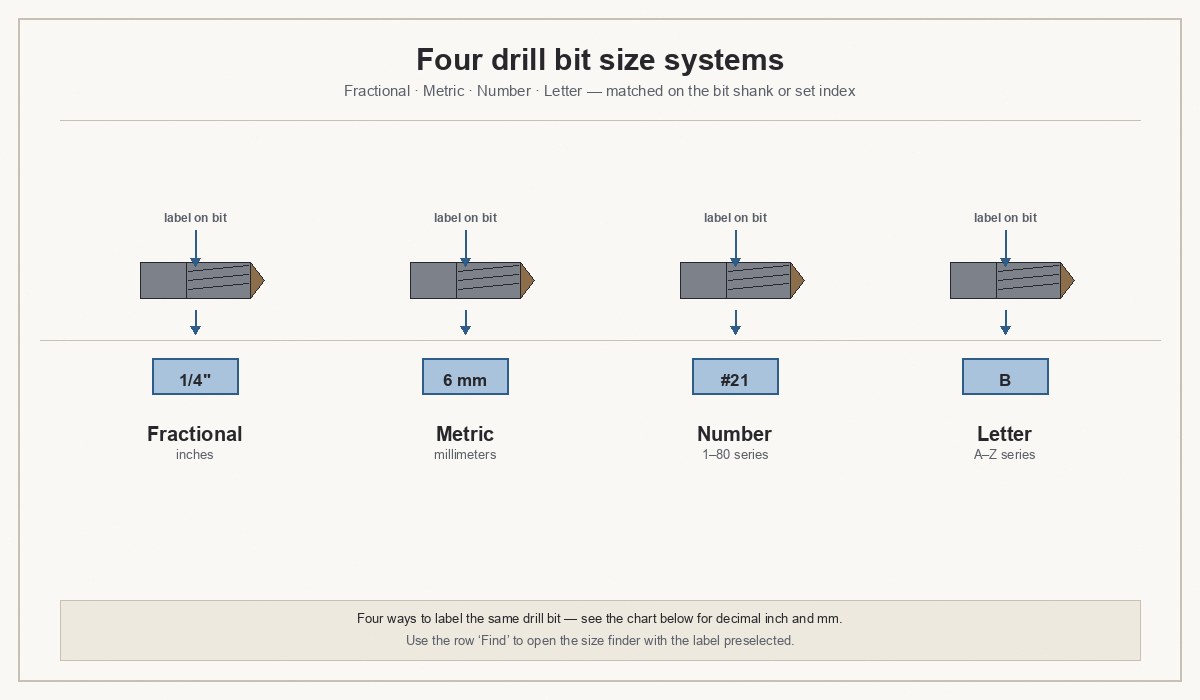
Millimeter diameters only — the labels printed on most imported and European index cases. Each row lists the metric label, decimal inch, and mm so you can match a drawing that specifies diameter in millimeters without hunting the full four-system chart. Need fractional, number, or letter sizes? Use the links below or the full chart.
Full size chart · Size finder · Drill hub · Fractional · Number · Letter
How to use this table
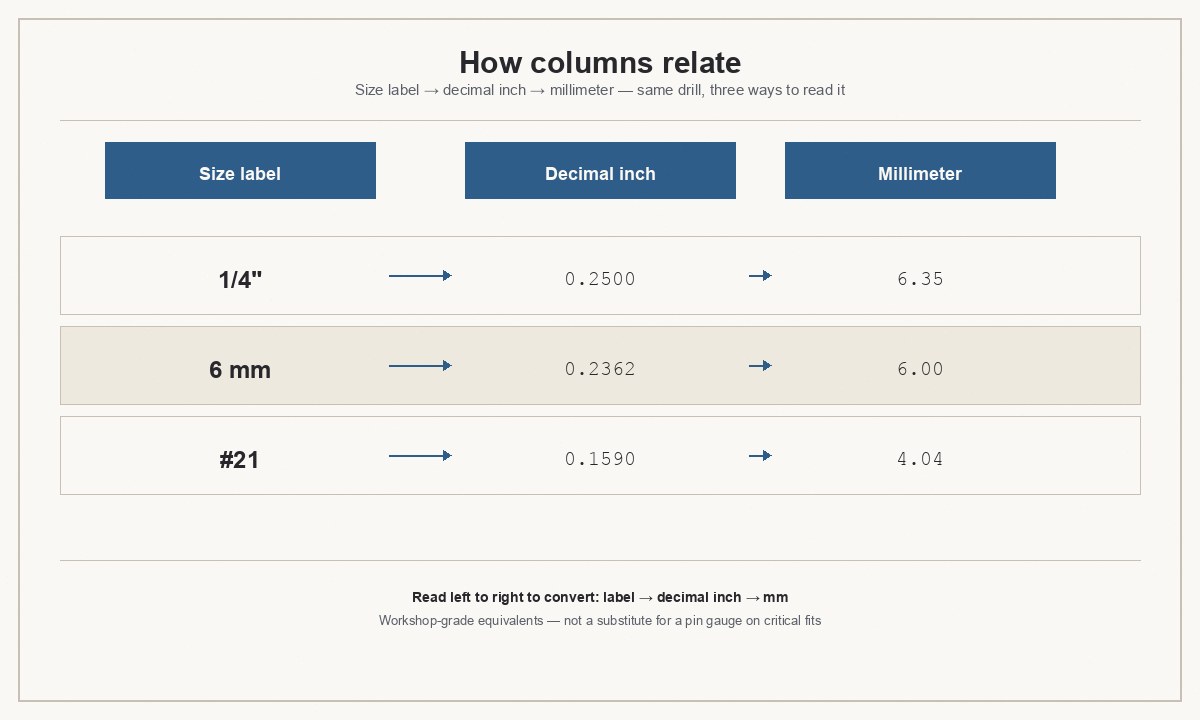
Scan the Size column for the millimeter stamp on your bit or the diameter on the plan. Decimal inch is a shop conversion (mm÷25.4), not a claim of lab tolerance or coating allowance. Click Find on a row to open the size finder with that label preselected — set matching lives on the tool page, not as a product grid here. US consumer sets often print fractional lids; if a metric size is not on the lid, the finder notes that instead of claiming a match.
Metric steps here run common shop increments from 1mm through 12mm. If your drawing calls 6.5mm and your case jumps from 6mm to 7mm, do not “round up” blindly for pilots in metal — check clearance versus body diameter first. For wood screws and hardware that arrived with inch guidance, cross-check the fractional series page or full chart before you open the hole.
Typical flow: read the mm mark on the bit or BOM, find the row, note decimal inch if you must talk to an inch-only index, then Find → size finder. Critical fits still need a gauge — table values are nominal workshop equivalents.
| Size | Inch (dec) | mm | Look up |
|---|---|---|---|
| 1mm | 0.0394 | 1.00 | Find → |
| 1.5mm | 0.0591 | 1.50 | Find → |
| 2mm | 0.0787 | 2.00 | Find → |
| 2.5mm | 0.0984 | 2.50 | Find → |
| 3mm | 0.1181 | 3.00 | Find → |
| 3.5mm | 0.1378 | 3.50 | Find → |
| 4mm | 0.1575 | 4.00 | Find → |
| 4.5mm | 0.1772 | 4.50 | Find → |
| 5mm | 0.1969 | 5.00 | Find → |
| 5.5mm | 0.2165 | 5.50 | Find → |
| 6mm | 0.2362 | 6.00 | Find → |
| 6.5mm | 0.2559 | 6.50 | Find → |
| 7mm | 0.2756 | 7.00 | Find → |
| 8mm | 0.3150 | 8.00 | Find → |
| 9mm | 0.3543 | 9.00 | Find → |
| 10mm | 0.3937 | 10.00 | Find → |
| 12mm | 0.4724 | 12.00 | Find → |
Drill bit set (shop staple)
Metric labels often are not printed on US consumer set lids. Below is a common fractional set for general shop use — confirm mm equivalents with the table above, or open Find for honest set matching.
As an Amazon Associate we earn from qualifying purchases. Disclosure
FAQ
What are metric drill bit sizes?
Metric sizes are labeled in millimeters (for example 3mm, 6mm, 10mm). The decimal-inch column is a shop conversion so you can compare a metric bit to an inch plan or a fractional index case.
Is 6mm the same as 1/4"?
No. 6mm is 0.2362" nominal; 1/4" is 0.2500" (6.35mm). Close for rough work, not interchangeable for precision pilots or reamed fits. Use both columns before you force a match.
Which metric sizes are common in home kits?
Many mixed sets include 3mm, 4mm, 5mm, 6mm, 8mm, and 10mm. This table lists the verified metric rows in our dataset; click Find on a row to open the size finder with that label.
Where is the full four-system chart?
Open the drill bit size chart for fractional, metric, number, and letter together. This page is the metric series only for faster scanning.
Sources
Metric diameters follow common published mm drill indexes. Decimal-inch values are nominal conversions for comparison. Confirm critical fits on the bit or with a gauge.
See the site disclaimer for limits of use.